

The whispers of the future are growing louder in research labs and standardization forums worldwide. While 5G is still unfolding its potential, delivering unprecedented speeds and connecting billions of devices, the visionary groundwork for its successor has already begun. We stand on the precipice of the next great leap in wireless evolution: 6G technology. Promising not just an incremental upgrade but a foundational paradigm shift, 6G is poised to architect the world’s fastest networks, transcending the boundaries of pure communication to become an intelligent, sensing fabric that intertwines the physical, digital, and human worlds.
Imagine a network so seamless, so intuitive, and so powerful that latency becomes imperceptible, bandwidth is virtually infinite, and the internet anticipates your needs. This is the promise of 6G a move from connected things to connected intelligence. It envisions a future of holographic telepresence, precise digital twins of entire cities, autonomous systems operating with collective consciousness, and the tactile internet where you can feel a texture from across the globe.
This article delves deep into the architecture, potential, and profound implications of 6G, exploring how it will irrevocably shape the future of wireless communication and redefine human experience by the decade of 2030.
The Evolutionary Leap | From 5G to 6G
To appreciate the revolution of 6G, one must understand the foundation laid by 5G. 5G introduced us to three core promises: Enhanced Mobile Broadband (eMBB), Ultra-Reliable Low Latency Communications (URLLC), and Massive Machine-Type Communications (mMTC). It operates primarily in sub-6 GHz and millimeter-wave (mmWave) bands, aiming for peak data rates up to 20 Gbps and latency as low as 1 ms.
However, 6G is not merely about “faster 5G.” It represents a fundamental reimagining. The core paradigm shifts from communication-only to Integrated Sensing and Communication (ISAC), where networks perceive their environment. It transitions from cloud-native to AI-native networks, with embedded artificial intelligence orchestrating resources in real-time. While 5G connects devices, 6G will fuse the physical and digital realms into a cohesive, intelligent ecosystem, supporting applications we are only beginning to conceptualize. For a deeper look at how AI is already transforming other fields, consider reading about transforming business with AI ERP systems.
5G vs. 6G | A Comparative Snapshot
| Parameter | 5G (IMT-2020) | 6G (Envisioned IMT-2030) |
|---|---|---|
| Peak Data Rate | 20 Gbps | 1 Tbps (1000 Gbps) and beyond |
| User Experienced Rate | 100 Mbps | 1-10 Gbps consistently |
| Latency | 1 ms (URLLC) | 0.1 ms (sub-millisecond, near zero-latency) |
| Frequency Bands | Sub-6 GHz, mmWave (up to 71 GHz) | mmWave, Terahertz Waves (100 GHz – 3 THz), and smarter use of lower bands |
| Spectrum Efficiency | 3x of 4G | 10-100x of 5G |
| Connection Density | 1 million devices/sq. km | 10-100 million devices/sq. km |
| Core Paradigm | Cloud-Native, Network Slicing | AI-Native, Cognitive Networks, Integrated Sensing & Communication |
| Key Enabler | Massive MIMO, Edge Computing | AI/ML, Reconfigurable Intelligent Surfaces, Terahertz, Quantum Communication |
The Technological Pillars of 6G Networks
The astronomical goals of 6G rest on several groundbreaking technological pillars currently under intense research. These are not mere improvements but new fields of engineering that will converge to create the network fabric of the future.
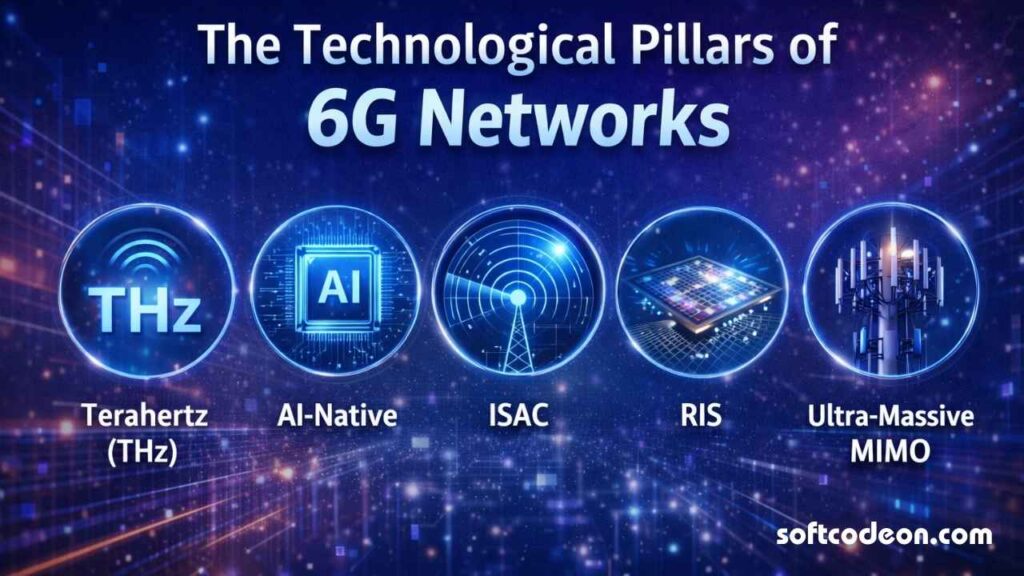
1. Terahertz (THz) Spectrum Utilization: To achieve terabit-per-second speeds, 6G will venture into the largely unexplored terahertz waves (0.1 THz to 10 THz). This vast frontier of spectrum offers enormous bandwidth but comes with challenges like high propagation loss and short range, necessitating ultra-dense networks and revolutionary antenna technologies.
2. AI-Native and Cognitive Network Architecture: AI won’t just be an application on 6G; it will be its nervous system. AI-native networks will be self-optimizing, self-healing, and self-securing. They will intelligently allocate resources, predict network failures, and manage traffic in real-time, creating cognitive networks that learn, adapt, and evolve autonomously.
3. Integrated Sensing and Communication (ISAC): This is perhaps the most transformative pillar. 6G base stations and devices will double as high-resolution radar and imaging sensors. By analyzing signal reflections, the network can map environments, detect motion, and even recognize gestures, enabling applications from traffic monitoring to health vitals tracking without dedicated sensors. This aligns with the broader trend of devices with advanced sensing capabilities, like those seen in the Lava Blaze Curve 5G’s hidden features.
4. Reconfigurable Intelligent Surfaces (RIS): Imagine painting walls and windows with a smart metamaterial that can manipulate electromagnetic waves. RIS are programmable surfaces that can control the wireless environment reflecting, focusing, or absorbing signals to eliminate dead zones, boost energy efficiency, and enable precise sensing.
5. Advanced Antenna Technologies: Ultra-Massive MIMO & Holographic Beamforming: Building on 5G’s Massive MIMO, 6G will deploy antenna arrays with orders of magnitude more elements. Coupled with holographic beamforming, these will generate highly focused, dynamic “beams” of data that follow users with pinpoint accuracy, maximizing efficiency and security.
Key Potential Applications of 6G
The capabilities of 6G will birth applications that sound like science fiction today, fundamentally transforming every sector.
- True Immersive Extended Reality (XR) & Holographic Telepresence: 6G’s zero-latency and terabit data rates will make photorealistic, real-time holograms a reality for communication, entertainment, and remote work, creating a genuine sense of “being there.”
- Tactile Internet and Remote Expert Systems: Surgeons will be able to perform remote operations with haptic feedback, feeling the resistance of tissue through robotic tools. Engineers will manipulate machinery from thousands of miles away as if their hands were on the controls.
- Precision Digital Twins of Cities and Planets: Networks will continuously update massive, atomically precise digital twins of infrastructure, ecosystems, and even human bodies, enabling predictive maintenance, climate modeling, and personalized medicine. This concept of creating seamless digital counterparts is a cornerstone of future tech, much like the goal of advanced WordPress page builders to perfectly mirror a designer’s vision.
- Ubiquitous AI and Autonomous Collective Systems: Beyond single autonomous vehicles, 6G will enable swarms of drones, cars, and robots to communicate and collaborate in real-time, forming a collective intelligence for logistics, disaster response, and agriculture.
- Neurotechnology and Human-Machine Symbiosis: High-fidelity, low-latency brain-computer interfaces could become viable, allowing for direct communication between the human nervous system and the digital world.
Global Research Initiatives and the Road to Standardization
The race for 6G is a global endeavor, with nations and consortia investing billions. Key players include:
- Hexa-X & Hexa-X-II (EU): Flagship projects focusing on connecting human, physical, and digital worlds with sustainability at the core.
- Next G Alliance (USA): An industry led group aiming to advance North American leadership in 6G.
- IMT-2030 (6G) Promotion Group (China): Driving research and standardization efforts within China.
- South Korea & Japan: Both have ambitious national strategies targeting 6G commercial launch around 2030, with companies like Samsung and NTT Docomo leading foundational research.
Official standardization under the ITU’s IMT-2030 framework is expected to begin around 2025-2026, with the first commercial deployments anticipated around 2030. This global collaboration and competition will ultimately define the standards that shape our connected future.
Challenges and Ethical Considerations on the Path to 6G
The path to this utopian connectivity is fraught with significant hurdles that must be addressed responsibly.
- Technical Challenges: Harnessing the terahertz spectrum requires new semiconductor materials and circuit designs. The energy consumption of such dense, always-sensing networks is a major concern, demanding breakthroughs in energy harvesting and ultra-low-power design. Furthermore, the complexity of AI-native networks introduces new vulnerabilities, making security and privacy paramount, especially with pervasive sensing capabilities. Ensuring robust security is as critical for networks as it is for websites, a principle outlined in our Ultimate WordPress Security Guide.
- Infrastructure and Cost: Deploying a global network of intelligent surfaces, ultra-dense cells, and integrated sensing nodes will require astronomical investment and unprecedented international cooperation.
- Ethical and Societal Implications: The power of 6G raises profound questions. Pervasive sensing could lead to unparalleled surveillance if not governed by strict ethical frameworks. The digital divide could widen if access to 6G’s benefits is not equitable. Furthermore, the environmental impact of manufacturing and powering such an extensive network must be a central design criterion, not an afterthought.
Conclusion
6G technology is more than the next “G” in a sequence; it is the blueprint for a new kind of societal infrastructure. It promises to weave a connective tissue so advanced that it becomes invisible, intuitive, and infinitely empowering. By delivering the world’s fastest networks with integrated sensing and native intelligence, 6G has the potential to solve grand challenges in healthcare, climate science, resource management, and human connectivity.
However, this future is not predetermined by technology alone. It will be shaped by the choices we make today in research labs, policy forums, and standardization bodies. The goal must be to steer this immense power toward a human-centric future one that prioritizes ethical design, universal access, sustainability, and security. As we stand at this early dawn of the 6G era, our collective responsibility is to ensure that this revolutionary force for connection becomes an unequivocal force for good, shaping a world that is not only smarter and faster but also more equitable and resilient.
The journey to 2030 begins now, and its foundation rests on the innovative spirit driving all digital advancement, much like the ingenuity behind the best AI tools to make money online today.