

Parasite SEO has been a whispered tactic in digital marketing circles for years. Some marketers swear by it as a fast track to page one, while others warn it’s a dangerous game that can torch your brand’s reputation overnight. But here we are in 2026, and Google’s algorithm has evolved through multiple core updates including the March 2026 Helpful Content Update that specifically targeted “site reputation abuse.” The question every serious publisher is asking is blunt: Does Parasite SEO still work, and more importantly, is it safe to attempt?
If you have been paying attention to search results lately, you’ve likely noticed something interesting. Even with Google’s aggressive crackdown on spam, certain high-authority domains like LinkedIn, Medium, GitHub, and Reddit still dominate top positions for competitive keywords. This isn’t an accident. It’s the lingering fingerprint of Parasite SEO leveraging someone else’s domain authority to rank content faster than you ever could on a fresh website. But the rules of engagement have changed dramatically. What worked in 2024 will now get you manually penalized. In this article, I’ll walk you through exactly what Parasite SEO looks like in the current landscape, how to execute it safely, and whether you should even bother investing time in this strategy anymore.
What Is Parasite SEO and How Has It Evolved by 2026?
Before dissecting the safety protocols for 2026, we need to level-set on definitions. Parasite SEO is the practice of publishing content on a third-party website with extremely high domain authority (DA) to piggyback off that site’s trust signals and ranking power. Think of it like renting a stall inside a massive shopping mall instead of building your own storefront in the desert. You get instant foot traffic, but you don’t own the lease, and mall security can kick you out whenever they want.
In the early 2020s, this strategy was almost too easy. Marketers would spin up a free Medium account, stuff an article with affiliate links, and rank for “best VPN” within 48 hours. However, the 2025-2026 algorithm shifts have introduced new scrutiny. Google now explicitly evaluates “site reputation abuse” under its spam policies. If a high-authority site hosts content completely unrelated to its core purpose like a university domain hosting casino affiliate reviews Google will deindex that URL or penalize the subdomain. The game has shifted from “post anywhere” to “strategically align with relevant platforms.”
The Core Mechanics: Why High DA Sites Still Win in 2026
The fundamental physics of SEO haven’t changed entirely. Google’s ranking algorithm still places disproportionate weight on domain-level trust. A new blog post on a domain with a Domain Rating (DR) of 90+ inherits baseline credibility simply because it lives under the same roof as thousands of trusted pages. Even with 2026 updates, Google’s crawlers take time to fully demote a specific URL if the root domain is a powerhouse like Microsoft.com or LinkedIn.com.
This is why Parasite SEO continues to show pockets of effectiveness. When you publish on LinkedIn Articles, you’re not just getting a backlink you’re getting the full force of LinkedIn’s crawl budget and indexation speed. In 2026, this is crucial because Google’s “Indexing Prioritization” update means new content on low-authority sites can sit in the discovery queue for weeks. Meanwhile, a well-formatted post on a high-DA host can be indexed and ranking for long-tail keywords in under four hours. The catch? Content quality must now match the host’s editorial standards, or the page simply won’t stick.
Why the Term “Parasite” Is Misleading in 2026
The word “parasite” implies a harmful, one-sided relationship. In SEO 2026, this is exactly what you want to avoid. If your content is thin, promotional, or stuffed with spammy affiliate links, you’re indeed a parasite and the host platform’s moderators will remove you. Worse, Google’s SpamBrain AI is now sophisticated enough to identify “commercial intent mismatch” even if human moderators miss it.
The modern approach, which I prefer to call “Symbiotic Authority Stacking,” requires you to provide genuine value to the host platform’s ecosystem. For example, if you publish a detailed technical breakdown on GitHub Gist about a coding framework, you’re adding to GitHub’s knowledge repository. In return, GitHub rewards you with a fast-loading, trusted URL. By 2026, Google has gotten very good at distinguishing between a symbiotic contribution (which keeps ranking) and a parasitic leech (which gets deindexed).
The 2026 Algorithm Update: Is Parasite SEO Still Effective?
This is the million-dollar question. The answer is a cautious, nuanced “Yes, but only if you do it the hard way.” The era of easy wins with Parasite SEO is over. The barriers to entry have been raised so high that it’s now almost as much work to run a successful parasite campaign as it is to build authority on your own domain.
Independent tracking shows that while spammy parasite pages are getting flagged faster (average lifespan dropped from 9 months in 2024 to just 6-8 weeks in 2026), high-effort, editorial-style content on trusted platforms is holding steady. Google isn’t trying to kill Forbes’ expert columns or LinkedIn’s thought leadership. Google is trying to kill the ability of an unknown affiliate to rank a weight loss supplement review on a hacked subdomain. If your content looks like it could pass a major magazine’s editorial review, you’re playing in a different league.
How Google’s March 2026 Core Update Targets Site Reputation Abuse
The March 2026 Core Update was a watershed moment. Google updated its Site Reputation Abuse Policy with an addendum targeting “third-party content on trusted domains that deviates significantly from the site’s primary purpose without adequate editorial oversight.” Translation: If you write about “Online Casino Bonuses” and post it on a public university’s blog, Google will actively penalize that URL path.

This has chilled the aggressive corners of Parasite SEO. We saw massive visibility drops for “PDF sharing” sites and “cloud storage” preview links. However, platforms with built-in editorial friction like LinkedIn’s connection requirements or Reddit’s karma threshold have actually seen their search visibility increase because Google views that friction as a quality filter. The takeaway for 2026: Context is king. If the host site is a natural home for the topic, risk is manageable. If the host site is unrelated, you’re on borrowed time.
Ranking Case Studies: Parasite Pages vs. Niche Authority Sites in 2026
Here’s a snapshot comparing a well-executed Parasite SEO play versus a dedicated niche site approach in 2026:
| Feature / Metric | Parasite SEO (High-DA Platform) | Niche Authority Site (Own Domain) |
|---|---|---|
| Time to First Page Rank | 24-72 hours | 3-9 months |
| Stability of Ranking | Low to Medium (Volatile during updates) | High (Steady growth) |
| Monetization Control | Limited (Can’t place ads, restricted links) | Full (AdSense, sponsors, any affiliate) |
| Risk of Content Removal | High (Platform TOS changes) | Zero (You own the asset) |
| 2026 Viability for Commercial Keywords | Decreasing rapidly | Increasing for established sites |
Parasite SEO in 2026 is a sprinter’s strategy, while building your own site is a marathon. For time-sensitive news like the latest Samsung Galaxy S25 Edge launch a parasite platform gives you that initial burst. But for comprehensive reviews, you want traffic on your own asset.
Is Parasite SEO Safe? Analyzing the Risks and Rewards in 2026
Safety in SEO isn’t just about avoiding Google penalties it’s about protecting your long-term revenue stream. I’ve seen entrepreneurs build entire businesses on rented land only to see them wiped out overnight. In 2026, the safety of Parasite SEO exists on a spectrum.
If you’re using Parasite SEO for top-of-funnel brand awareness or to secure a featured snippet for a non-commercial query, the risk profile is low. If you’re funneling users to gray-hat affiliate offers in the health niche, you’re playing with fire. Let’s break down where the dangers lie.
Understanding Manual Actions vs. Algorithmic Suppression
Many panic when their parasite page drops from position #3 to #30, assuming they’ve been “penalized.” In most 2026 cases, this isn’t a manual action. A manual action involves a human reviewer flagging your page with a Search Console notification rare for parasite pages because reviewers focus on the root domain owners.
What you’re experiencing is Algorithmic Suppression. The 2026 algorithms have a classifier for “Thin Affiliate Content on High DA Sites.” When triggered, it doesn’t penalize the whole domain it just removes your URL from commercial query competition. You won’t see a warning; your traffic simply evaporates. This is safer for your personal brand (no black mark), but fatal for the strategy. The primary 2026 risk is wasted effort, not a formal ban.
Common Pitfalls That Lead to Deindexation
Even without a manual action, your content can vanish completely. Here are the top three deindexation triggers in 2026:
- Noindex Tags Added by the Host: Medium and LinkedIn have automated systems scanning for excessive affiliate links. If triggered, a
noindexmeta tag is silently applied. - Canonical Conflicts: Duplicating the exact article on your blog and the parasite host can confuse signals and drop the page from the index.
- User Reports: The “Report Spam” button in Chrome is powerful. A few reports can trigger automated quality reviews.
Does It Hurt Your Main Website?
In 99% of 2026 cases, no. Google understands bad actors can link without your consent. However, one scenario can hurt: Aggressive Interlinking. If you use exact match anchor text (“cheap web hosting India”) from a parasite page that gets flagged, Google’s algorithms may devalue those specific links. I’ve covered safe linking extensively in my guide on building quality backlinks with white hat SEO. The key is branded or natural anchor text “Check out SoftCodeOn’s review” rather than “Buy Best Web Hosting.”
Which Platforms Are Still Viable for Parasite SEO in 2026?
The landscape has shrunk. Free-for-all Blogspot and WordPress.com subdomains are devalued. In 2026, viable platforms have strict moderation, high editorial standards, and thematic match with content. If a platform lets you sign up with a burner email and publish 20 outbound links in 5 minutes, it’s no longer viable. Your efforts are better spent on the platforms below.
LinkedIn Articles: The B2B Powerhouse
LinkedIn remains the undisputed Parasite SEO champion for B2B in 2026. Its domain is astronomically strong, and Google understands content comes from verified professionals. Articles index within minutes.
However, LinkedIn has tightened quality algorithms. Articles under 800 words lacking engagement within 24 hours get pushed down. To make LinkedIn work, leverage your network 10+ relevant comments send massive trust signals. If you’re analyzing SEO predictions and trends for 2026, LinkedIn is ideal because audience and platform purpose align perfectly.
Medium: Navigating the Paywall and Google’s View
Medium’s relationship with SEO is “complicated.” The key differentiator is Metered (Friend Link) vs. Locked (Members Only). Google indexes preview text of locked articles, but they rarely rank top 10 due to paywall friction.
To use Medium effectively in 2026, you must use a Friend Link so Googlebot sees full text. But Medium’s internal “Boost” curation now heavily influences rankings. Without human curator approval, ranking on page one is extremely difficult. Writing quality must be top-tier engaging, well-formatted, free of keyword stuffing. Medium is now for building thought leadership, not a spam cannon.
Reddit and Quora: Leveraging UGC for Long-Tail Wins
Reddit’s Google visibility has exploded in 2026 due to Google’s “Hidden Gems” system and the official data partnership. You can’t post a 2,000-word article on Reddit, but you can provide a high-value answer to a specific question.
A detailed, helpful comment in a relevant subreddit can rank page one for long-tail queries. I’ve seen Reddit comments outrank entire niche websites. The catch? Your account needs karma and age. New accounts posting links get shadowbanned instantly. Provide the answer in full on Reddit, then subtly mention “I wrote a more detailed breakdown [here]” only if it genuinely adds value.
Niche-Specific Sites: GitHub and Industry Forums
This is where smart money goes in 2026. Instead of massive generalist platforms, target thematically relevant platforms.
- GitHub Gist / Repositories: For tech content, a well-documented Markdown file on GitHub ranks incredibly well for coding tutorials. Writing about the future of coding with AI and hosting code snippets on GitHub is textbook symbiotic authority stacking.
- Industry Review Platforms: Sites like G2 or Capterra have tremendous authority. A genuine, detailed software review with a link back in your profile is low-risk, high-reward, and completely white hat.
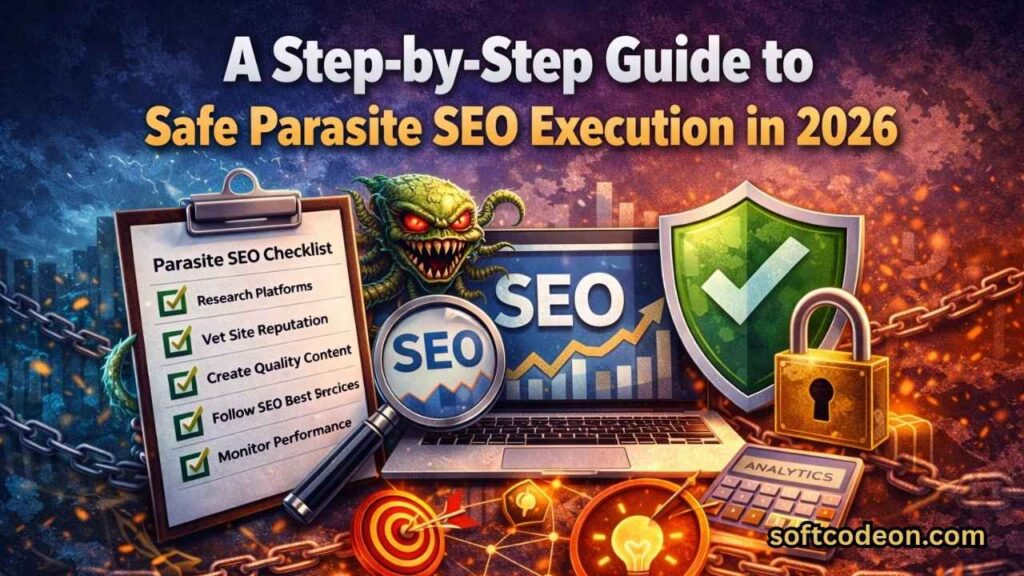
A Step-by-Step Guide to Safe Parasite SEO Execution in 2026
If you still want to try this strategy, let’s do it properly with a professional workflow that minimizes risk and provides genuine value to readers.
Step 1: Identifying the Right Keywords for Parasite Plays
You cannot target the same keywords on parasite platforms that you target on your own site. “Best Web Hosting 2026” won’t rank on Medium Google expects that query answered by dedicated review sites.
Target Information Intent or News/Current Event keywords queries where users want quick definitions, opinions, or breaking news. These align with fast-indexing parasite hosts.
- Good Parasite Keywords: “What is Generative Engine Optimization?” “When will Tesla Phone release in India?” “180 days from today meaning.”
- Bad Parasite Keywords: “Buy iPhone 17 Pro Max cheap.” “Best credit card signup bonus.”
Step 2: Crafting Content That Passes AI Detection and Moderation
The standard for parasite content in 2026 must be 100% human-written and pass AI detection. Host platforms use AI detectors, and Google’s algorithm essentially is one.
To ensure human-read content, include Personal Experience and Specific Anecdotes. Instead of “The Suzuki Hayabusa has a powerful engine,” write “When I first twisted the throttle on a friend’s Hayabusa, the acceleration wasn’t just fast it was visceral, chest-compressing power.” That’s a human sentence with emotion and specificity AI struggles to replicate convincingly.
Step 3: Strategic Internal and External Linking
This is the most technical and risky part. How do you link back safely?
| Linking Type | Recommended Anchor Text Strategy | Notes for 2026 |
|---|---|---|
| Link 1 (Primary) | Branded / Naked URL (e.g., “SoftCodeOn”) | Safest option. Reinforces brand search. |
| Link 2 (Secondary) | Natural Long-Tail (e.g., “covered this in more detail separately”) | Contextual and low-risk. |
| Link 3 (External Authority) | Link to trusted source (Wikipedia, .gov, Statista) | Crucial Step. Linking only to yourself is a red flag. Linking to Google Webmaster Guidelines signals curation, not self-promotion. |
| Link 4 (Avoid) | Exact Match Commercial (e.g., “Buy Cheap Web Hosting”) | Do not do this. Fastest way to deindexation. |
Step 4: Monitoring Indexation and Performance
Without direct GSC access for parasite URLs, you’re flying blind. Use Third-Party Rank Trackers (SERPWatcher, AccuRanker) to monitor specific URL positions. Check page status using the site: operator type site:your-parasite-url.com into Google. If the page doesn’t show, it’s noindexed or deindexed. This monitoring is non-negotiable.
Parasite SEO vs. Building Your Own Niche Authority
You have limited time. Should you spend 10 hours on a killer parasite article or 10 hours building pillar content on your own domain? In 2026, the answer has shifted toward Building Your Own Asset. I recommend a 90/10 split 90% effort on your website, 10% on strategic parasite placements for time-sensitive opportunities.
| Strategic Goal | Better Strategy: Parasite SEO | Better Strategy: Own Domain |
|---|---|---|
| Quick Traffic Spike | ✅ Excellent | ❌ Slow |
| Long-Term Passive Income | ❌ Poor (Too volatile) | ✅ Excellent |
| Brand Building | ⚠️ Decent for Awareness | ✅ Superior for Trust |
| Monetization with Ads | ❌ Impossible | ✅ Full Control |
When to Use Parasite SEO in 2026
Two scenarios justify Parasite SEO:
- News Jacking: A new product dropped. You want page one today for “Nothing Phone 3A Pro First Impressions.” Your site takes 3 months; a LinkedIn article takes 3 hours.
- Reputation Management: Pushing negative results off page one for your brand name by building optimized LinkedIn and Medium profiles.
When to Avoid Parasite SEO
If your goal is ranking for a keyword that makes money directly (“Buy SEO Services” or “Honda Rebel 1100 Price”), avoid parasite SEO. Google actively shows business websites for commercial queries, not Medium posts. Conversion rates from generic platforms are abysmal. For YMYL niches (health, finance), do not touch it. Google has devalued third-party content here unless authors have verified credentials. For deep guidance on handling sensitive topics, check my guide on showcasing experience for YMYL sites.
Conclusion: Should You Rely on Parasite SEO in 2026?
So, does Parasite SEO still work in 2026? Yes, as a targeted tactical strike, not a broad war strategy. It’s no longer safe to rely on as a primary income stream. The risks of deindexation and effort required to maintain a “safe” parasite profile now rival the effort of building a decent niche site.
Is it safe? Only if you provide genuine value and treat the host platform with respect. If you’re looking for a shortcut to bypass building topical authority, you’ll be disappointed and potentially penalized. The smartest SEOs in 2026 use these platforms to amplify existing authority, not create it from thin air.
My recommendation: Use Parasite SEO to support specific launches, claim branded SERP space, or answer time-sensitive questions. But for sustainable traffic, do not build your house on rented land. Plant your flag on your own domain with reliable WordPress hosting and speed-optimized plugins and water it with consistent, high-quality content. That’s the balanced, safe, and effective approach for 2026 and beyond.
