


Let’s cut through the noise immediately: if you’ve heard that blogging is dead, you’ve been listening to the wrong people. The reality of blogging in 2026 isn’t about writing a diary entry and magically ranking first on Google anymore. That easy ride ended a decade ago. Today, the barrier to entry is higher, but the financial ceiling for beginners who treat this like a digital media business is astronomically higher. Google’s 2026 algorithm updates have killed off mass-produced AI spam, but they have heavily rewarded genuine subject matter experts who can demonstrate real-world experience.
The game hasn’t ended; the gamers have changed. The modern blogging ecosystem is a multi-billion dollar industry surviving on trust, not just keywords. New bloggers often fail because they chase passive income before building active authority. The truth is that 95% of new blogs fail within the first 18 months not because the market is saturated, but because the strategy is outdated. However, if you’re willing to move beyond generic “best [product]” lists and embrace what I call “Experience-Led SEO,” there is a massive blue ocean of opportunity. In this 2026 guide, we’re going to strip away the guru fluff and look at the exact mechanics, realistic income reports, and specific strategies that make a blog profitable in a post-AI world.
The State of the Blogosphere in 2026
The landscape has shifted dramatically from mere content creation to holistic brand building. Understanding where we stand historically helps us contextualize why the old “volume hacks” don’t work, but why individual authority has never been more valuable. The traffic graph didn’t disappear; it just moved from surface-level information to deep, experiential dives.
The Death of Generic Content and The Rise of “Experience”
For years, SEO “experts” preached that you could write about skydiving without ever jumping out of a plane. In 2026, that is a death sentence for a blog. Google’s Helpful Content System has evolved to penalize what I call “synthetic expertise” content that is grammatically perfect but lacks the physical or emotional texture of reality. Blogging in 2026 requires you to inject original photography, personal case studies, and unique data into every article. If the internet already has 500 identical reviews of the Samsung Galaxy S25 Edge, your article must include a personal video breakdown or a unique thermal performance test you conducted yourself to even stand a chance of indexing in the top 10.
Has AI Killed Human Bloggers?
Paradoxically, the rise of AI writing tools like Gemini 2.0 and ChatGPT-5 hasn’t killed human bloggers; it has automated the commodity parts of blogging so we can focus on the high-IQ strategy. Think of AI as a junior research assistant, not an author. Beginners often ask me why their perfectly written AI content doesn’t rank. The answer is simple: it lacks information gain. In 2026, AI-generated articles are recognizable because they summarize the consensus, but consensus doesn’t drive revenue; contrarian, expert insight does. The profitability now lies in your ability to use AI to speed up your work not to do the work for you.
Choosing a Profitable Niche in a Competitive Era
Picking a niche in 2026 is about finding the intersection between your personal obsession, market demand, and crucially areas where AI hallucinations are too risky for readers. Generic niches are dead; micro-segmentation is the only escape from competing with billion-dollar media conglomerates.
The “Digital Sharecropping” Trap vs. Owned Assets
Before you start, you must understand that a self-hosted WordPress blog is fundamentally different from building an audience on Instagram or LinkedIn. Social media platforms are rented land. A blog is an owned asset. In 2026, relying solely on search traffic without building an email list is a form of digital sharecropping; an algorithm update can wipe you out overnight. The most profitable beginners are those who use organic search to discover their audience, but immediately funnel that attention into deeper, owned channels like newsletters and private communities. This shifts your blog from an SEO farm to an asset with exit value.
3 Underrated Sub-Niches for 2026 Beginners
Most newcomers rush into “Credit Cards” or “Web Hosting,” only to be crushed by giants. The real profit is in unsexy, high-stakes problems. Here are three sub-niches that are printing money in 2026 because they require actual experience and carry massive purchasing intent:
- Regulatory Compliance & Safety Interpretation: Sites like my breakdown of this sign shows when a lift is safe to use target blue-collar professionals and facility managers. Google heavily favors clear, visual safety breakdowns because getting this information wrong has legal consequences.
- Legacy Tech Maintenance: While everyone writes about the latest AI, there’s a massive shortage of content on repairing and maintaining legacy hardware. This audience is aging, has high disposable income, and isn’t satisfied with TikTok-style explanations.
- “Boring” B2B SaaS Workflows: Forget marketing tools; focus on enterprise process automation. Writing in-depth technical guides on topics like invoice approval automation workflow softwares attracts commercial intent readers who are actively solving $100,000+ business operation problems.
The 2026 Technical Setup
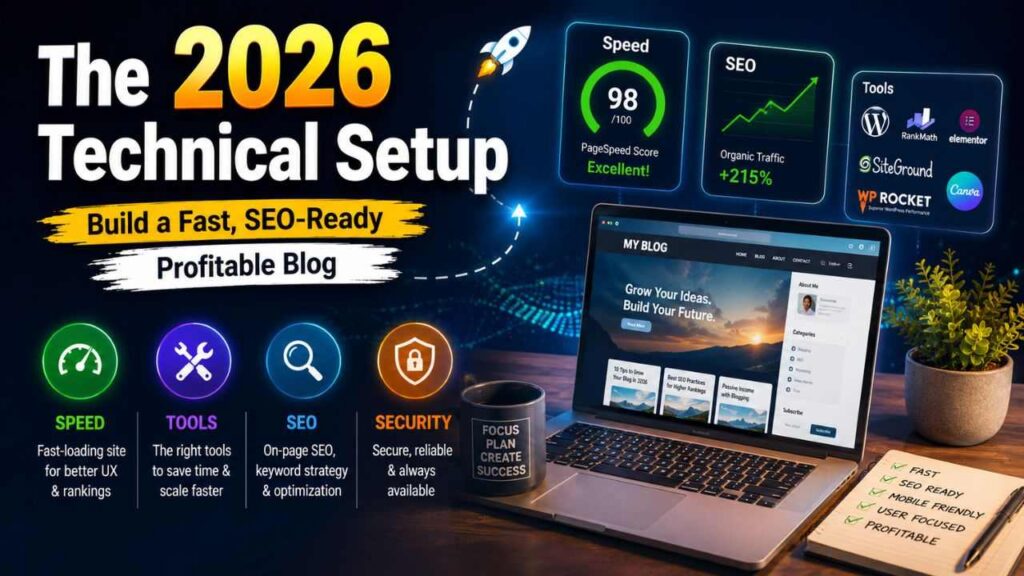
Your tech stack is your profit margin. In 2026, a slow, clunky website doesn’t just annoy users; it bleeds money. I’ve seen blogs with great content fail simply because their Core Web Vitals were in the red. The setup process is no longer about just installing a theme; it’s about engineering a lightning-fast, conversion-optimized machine from day one.
Why Speed is a Direct Ranking Factor
If your site takes three seconds to load, you’ve already lost 40% of your potential customers before they even read your expertise. For a new blogger in 2026, chasing a perfect 100/100 on Google PageSpeed Insights isn’t a vanity metric; it’s a competitive advantage against legacy sites that are bloated with code debt. Modern performance plugins like FlyingPress have changed the game by automating critical CSS generation and font optimization, eliminating render-blocking resources without requiring a backend developer. I’ve personally stress-tested various setups, and if you’re serious about speed, it’s worth studying how to balance different caching layers in this technical breakdown of Cloudflare APO vs FlyingPress Speed Race Winner to see exactly how caching logic affects your ad revenue and bounce rate.
Tools for a “Minimum Viable Blog” in 2026
To keep overheads low while you build traffic, you only need four things. Resist the urge to buy 20 premium plugins on day one; most of them just create security vulnerabilities and bloat your database.
- Hosting: You need a host that supports PHP 8.x and has built-in LiteSpeed caching. Look for “managed WordPress” solutions that have isolated resources so a traffic spike to a neighbor’s site doesn’t crash yours. The goal is to have server response times under 200ms.
- The “One Plugin” Rule: Instead of installing ten plugins for security, caching, and image optimization, look for all-in-one performance suites. The fewer moving parts in your stack, the fewer conflict errors you’ll have to debug later.
- The Writing Environment: Use a distraction-free editor that blocks AI autocorrect during the first draft. You need raw, unfiltered ideas first; syntax and grammar are edited later. This guarantees your voice remains distinct.
- Image Transformation: Never upload a raw PNG or JPEG from your camera. Use a tool to convert images to WebP or AVIF format. If you don’t have Photoshop, you can use a lightweight free online image converter tool to squash your file sizes by 70% without visible quality loss, keeping your bandwidth bills at zero.
Content Architecture & Semantic SEO Mastery
Writing in 2026 is less about “writing” and more about architecting information spaces. You don’t write a post; you build a topical map. Semantic SEO isn’t a buzzword; it’s the structural hierarchy that tells Google you are the definitive source on a subject, not just a one-hit wonder who got lucky with a single keyword.
The “Hub and Spoke” Model
You can’t just publish random articles and hope they stick. Google in 2026 is looking at your entire body of work. A site that publishes 30 articles purely about “Motorcycle Safety Gear” will almost always outrank a generalist tech site that writes one high-quality review of a helmet. You need to create a central “pillar” page (the hub) that broadly covers a topic, and then branch out into “spoke” articles that target the granular, long-tail questions. For instance, if your niche is digital marketing, your pillar might be a general guide on SEO, but your spoke articles would address highly specific pain points like how to check domain age in bulk for link prospecting. This demonstrates comprehensive coverage and signals to search engines that your site deserves a slot in the “Knowledge Graph.”
The Anatomy of a High-Ranking Article Format
Click-through rate (CTR) is an outright ranking signal now. If your title isn’t better than the current #1, you won’t steal the click, even if your content is better. Here is the exact structural blueprint I’ve used to achieve a 5-7% CTR on competitive informational queries:
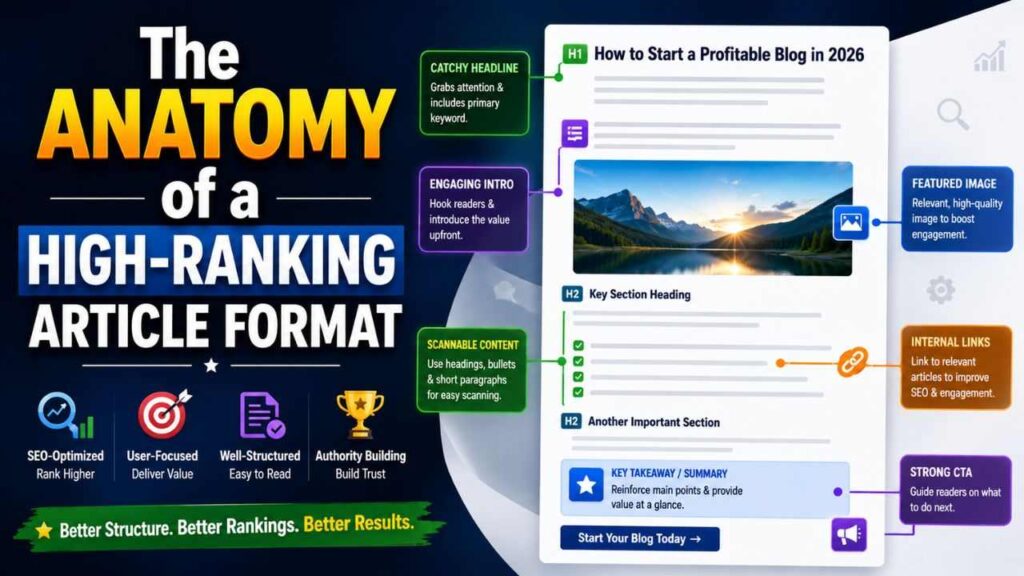
- The “Concept” H1: Your title needs to promise a specific outcome. Compare “Digital Marketing Tips” (weak) to “How to Make Your First $100 with Digital Marketing This Weekend” (strong). The latter signals urgency and a tangible result.
- The “Identity” Introduction: Your first 100 words must acknowledge the reader’s current pain point (e.g., “You’re exhausted by the 9-to-5 and tired of scams…”) before introducing yourself and your unique method. This connects on a human level and reduces the bounce-back-to-Google pogo-stick effect.
- Visual Information Density: Don’t just write paragraphs. Break down complex ideas into visual components. When explaining workflows, don’t just describe them; show the comparison logic in a data table. Readers skim, and tables hold the eye longer than a wall of text.
Monetization
If your only plan is to slap Google AdSense on a blog and pray, you will go bankrupt. Ad revenue for beginners in 2026 pays pennies unless you hit 50,000+ monthly sessions. The new profitability model relies on higher per-user value and monetizing the “messy middle” of the buyer’s journey.
The “Service-First” Funnel
This is the ultimate hack for 2026 profitability. Instead of writing an article to sell an affiliate product, write an article that solves a painful problem halfway, and offer the “done-for-you” service as the premium solution. For example, if you write an article about how tedious it is to manually process vendor bills, you can naturally funnel readers toward software solutions. This isn’t just a review; it’s a necessity. This is why coverage on topics like finding the top invoice approval tools you should try now converts at 5x the rate of a generic “best software” listicle, because the reader is already in the problem-solving mindset and just needs the final tool to execute.
| Monetization Method | Barrier to Entry | Profit Potential (2026) | Best Niche Fit |
|---|---|---|---|
| Display Ads (Mediavine/Raptive) | Medium (Traffic threshold) | Medium (15−35 RPM) | Lifestyle, Food, Broad-Tech |
| High-Ticket Affiliates | Low | Very High (10-30% commission) | B2B SaaS, Finance, Enterprise Hardware |
| Digital Products (Courses/Templates) | High (Need audience trust) | Extremely High (90% margins) | Coding, Design, Music Production |
| Service Booking (Freelancing) | Low | Immediate but Non-Scalable | Writing, Web Design, Consulting |
Affiliate Marketing
You will not get rich linking to $15 Amazon gadgets. In 2026, you need to target high-ticket B2B or subscription-based tools. Companies pay massive recurring commissions because the lifetime value of a customer is high. Instead of just pasting a link, you need to build a “bridge post.” This is a piece of content that captures a user searching for a free manual workaround, and presents the paid automation tool as the logical, time-saving upgrade. When discussing digital marketing strategies, for instance, linking to an educational resource on proven ways to make money with digital marketing provides context before the hard sell, warming the reader up and increasing conversion rates by framing the purchase as educational rather than transactional.
Brand Building and Link Acquisition in 2026
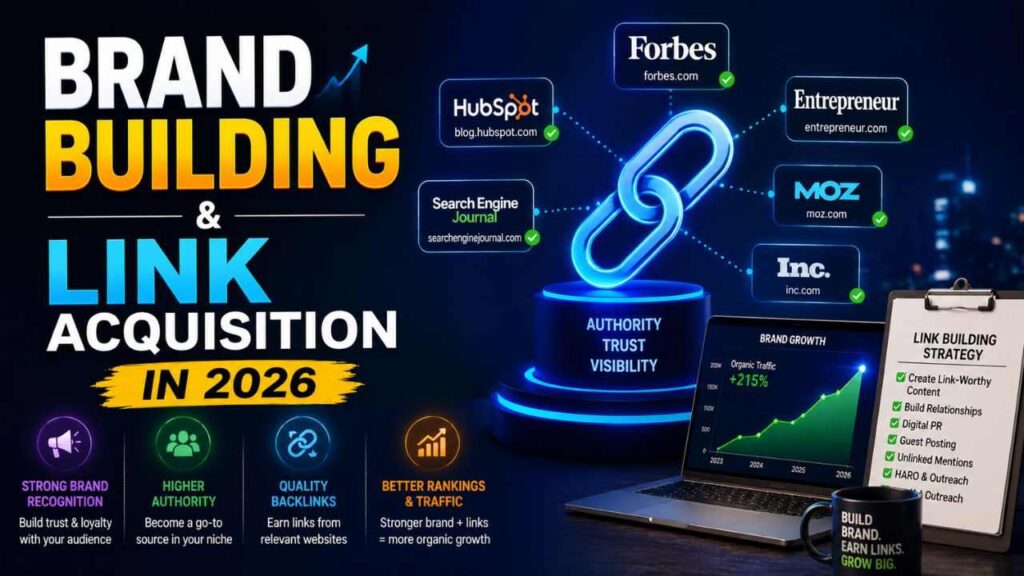
Links still rule the algorithm, but the methods to get them have completely reversed. Guest posting for the sake of a link is dying; digital PR and data journalism are thriving. Your ability to get cited by authoritative news sources will directly impact your Domain Rating (DR) and, more importantly, your ability to weather volatility during core updates.
“Parasite SEO” and Third-Party Authority Risks
Many beginners in 2026 are tempted by “Parasite SEO,” which is the practice of leveraging the authority of large platforms (like LinkedIn, Medium, or Reddit) to rank for high-value keywords quickly. While this can generate quick traffic for specific money pages, it is inherently dangerous and unstable. Platforms change their algorithms or remove your content without warning. When analyzing the current landscape, it’s critical to understand how parasite SEO does it still work is it safe in the context of a long-term business. It’s a legitimate tactic for short-term arbitrage, but for a beginner trying to build an exit-able asset, it’s a high-risk side hustle that shouldn’t distract you from building real domain authority on your own site.
The “Digital PR” Replacement Strategy
Instead of begging for guest posts, create assets that journalists need. A survey, a unique dataset, or a controversy map. Journalists are lazy in the most professional sense they are time-poor. If you publish a post titled “2026 Blogging Income Report: Survey of 500 Beginners,” you will naturally attract high-authority .edu and .org backlinks because you have created primary source data. This is the white-hat link building that scales infinitely.
The Future-Proof Blogger’s Toolkit
The tools you use dictate the quality of your output. There’s a fine line between using AI to augment your creativity and using it to replace your critical thinking. Google’s 2026 algorithm rewards the former and punishes the latter aggressively.
Automating the Grind Without Losing Your Soul
The boring stuff grammar checking, schema markup generation, and internal link analysis should be fully automated. You should not be spending 3 hours formatting a post. This is where AI copilots win. However, your “voice model” needs to be protected. If you rely on AI to generate the ideas, your content will asymptotically approach the average of the internet, which is a recipe for zero clicks. Use the tools to handle repetitive tasks so you can spend 80% of your time on the unique, personality-driven insights that no algorithm can replicate.
Protecting Your Content from “AI Slop” Filters
It’s an unfortunate reality in 2026 that even human writers are being falsely flagged as AI. To avoid this, do not write in perfect, unbroken prose. Humans hedge. Humans use sentence fragments. We change our minds mid-sentence. A literary critic once said, “The best writing is a conversation, not a lecture.” If your article looks like it was designed to pass a grammar checker with 100% accuracy, it will fail the AI detection check. To test this yourself, you can run your drafts through the latest AI content detector tools to ensure you haven’t accidentally slipped into a mechanical cadence. A good rule of thumb is to re-read your article aloud; if you run out of breath, your sentences are too uniform.
Your 120-Day Roadmap to $1,000/Month
Hope is not a strategy. You need a military-style operation for the first four months to build escape velocity. This timeline isn’t based on theory; it’s based on the cadence required to hit the indexing threshold where Google starts trusting your site as a regular publisher.
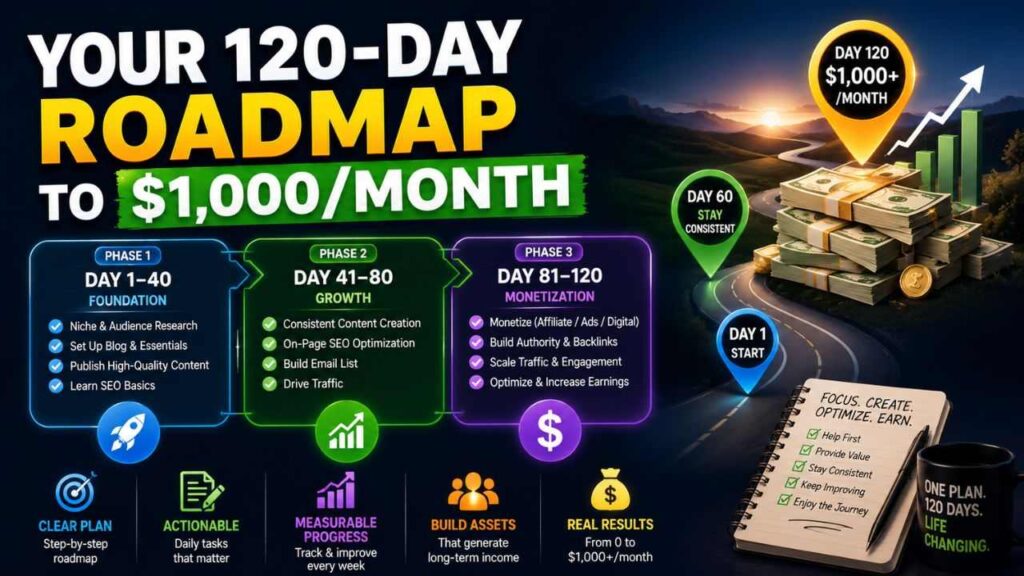
Phase 1: The “Sprint” Foundation (Days 1-30)
- Days 1-5: Niche selection and “entity” analysis. Don’t choose a niche; choose an audience. Build a persona.
- Days 6-15: Build the site structure. Publish your “About” page (the second most visited page on profitable sites), your Contact page, and a Privacy Policy.
- Days 16-30: Write and publish 10 “hygiene” content pieces. These are not money-makers; they are baseline trust signals. They answer easy questions correctly to establish relevance.
Phase 2: The “Middle Game” Assets (Days 30-60)
- Publish 5 “Link Magnet” assets. These are massive, definitive guides with custom graphics. Do not promote them yet; just get them indexed.
- Start the “PASO” loop (Publish, Analyze ranking movement, Surgically improve, Observe). Look at the Search Console data. Which queries have impressions but low clicks? Retweak those titles.
Phase 3: The “Acceleration” Push (Days 60-90)
- Manual Outreach: Identify 50 sites that linked to outdated articles from 2023. Email them with your updated 2026 version.
- Internal Linking Blitz: Go back to your old posts and add links to your new posts. This distributes the “link juice” and signals semantic relationships.
Phase 4: Monetization Onset (Days 90-120)
- Apply for the premium ad network waiting lists (even if you don’t qualify yet, join the list).
- Write your first “vs.” affiliate post (e.g., Tool A vs. Tool B). These high-intent comparison posts convert well even with lower traffic.
- Launch a “Lead Magnet” (a checklist or PDF) to start the email capture engine. This is your insurance policy against algorithm shifts.
Conclusion
So, is blogging in 2026 profitable for beginners? For the clueless, no. For the strategist, absolutely. The barrier to entry isn’t technical complexity; it’s the discipline to avoid shortcuts. We have entered the era of the artisan blogger someone who merges the precision of a data scientist with the soul of a storyteller. The AI search overviews will scrape the surface-level answers, but they cannot replicate the trust built by a human voice that has actually walked the path.
Your profit doesn’t come from the first click; it comes from the relationship built after the click. In 2026, the “get rich quick” tourists have packed their bags and left the blogging island, leaving behind the dedicated settlers who are building empires. The question isn’t whether it’s profitable; the question is whether you have the patience to build genuine value. If you start today, with the strategies laid out in this guide, you aren’t just chasing an algorithm you’re building a digital asset that will pay dividends for decades. The window is open. It’s time to start typing.
